Get expert data analysis support for your PICOT-based DNP Capstone project. We help you analyse clinical data, apply the right statistical tests, and interpret results with clarity—ensuring your project meets academic and practice-based standards.
At OnlineSPSS.com, we provide expert statistical consulting and data analysis services tailored for PICOT-based DNP Capstone and dissertations. Our mission is to simplify complex statistical tasks, so you can focus on what matters most—formulating clear clinical questions and delivering impactful, evidence-based results. Whether you’re evaluating healthcare interventions, comparing treatment outcomes, or analysing time-to-effect measures, our team delivers accurate, efficient, and publication-ready solutions.
Who We Help: PhD Students, Nursing and Medical Researchers, Clinical Academics Project Types: PICOT-Based Dissertations, DNP Capstone, Evidence-Based Practice Projects, Clinical Trials, Academic Assignments Our Services: Data Management, Statistical Analysis, Hypothesis Testing, Writing Methods and Results
Whether you work with IBM SPSS, R, Stata, NVivo, or another software, our statisticians are experienced in all tools required for PICOT data analysis. From refining your PICOT question to running the right statistical test and interpreting the results, we’re with you every step of the way.
👉 Get a FREE Quote todayand take the stress out of your PICOT-based DNP Capstone Project.
How Statistics Service Works
1. Submit Your Task
Click “Get Instant Quote” fill in required details, and upload supporting files.
2. Make the Payment
Pay securely through PayPal after receiving your custom quote.
3. Get Your Solutions
Receive high-quality, plagiarism-free results via email on time.
1. What is a PICOT Question for DNP Capstone?
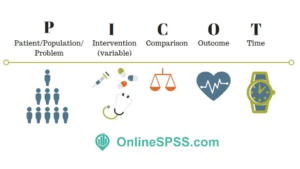
A PICOT Question for DNP Capstone is a structured clinical inquiry tool that helps doctoral nursing students define the focus of their evidence-based project. PICOT stands for Population, Intervention, Comparison, Outcome, and Time—five essential elements that transform a general clinical issue into a specific, researchable question. This format allows DNP candidates to identify gaps in practice, evaluate outcomes, and implement quality improvement interventions supported by measurable data. if you need more information about PICOT, please visit the PICOT Question Page
PICOT Framework
Using a PICOT Question for DNP Capstone ensures the project is aligned with both academic rigour and clinical relevance. It not only helps guide literature review and intervention design but also determines the type of data to collect and the statistical analysis methods needed. Whether you are evaluating a nursing protocol, testing a new intervention, or assessing patient outcomes, a well-constructed PICOT question strengthens the overall foundation of your Capstone project.
👉 Get a FREE Quote today to simplify your PICOT Question for DNP Capstone.
2. What is PICOT? Structuring Clinical Questions
PICOT is a mnemonic for the five key elements of a well-built clinical or research question. Each element focuses the inquiry:
Population (P)
The patient population or problem of interest – the group of people you intend to study. This should be clearly defined by characteristics like condition, age, setting, etc. (e.g. adults 18–60 with chronic neck pain). A balance is needed so the population is specific enough to be relevant, yet broad enough to be generalizable.
Intervention (I)
The main intervention or treatment being considered (e.g. a drug, procedure, educational program, or exposure). This is what is being applied to the population in hopes of an effect.
Comparison (C)
The alternative to the intervention – often a control or standard care group for comparison. Not every question has a direct comparison, but when applicable this could be a placebo, another treatment, or no intervention. In clinical trials this is the control arm (possibly the current gold-standard treatment).
Outcome (O)
The effect or result you plan to measure to determine the intervention’s impact. Outcomes should be clinically relevant and measurable (e.g. symptom improvement, recovery rate, complication occurrence). Choosing validated outcome measures improves the quality of the study.
Time (T)
The timeframe for observing the outcome. This might be the duration of follow-up or how long it takes to see the effect (e.g. 6 weeks of treatment, 1 year follow-up). Not every question specifies a time, but including one can clarify the context (acute vs. long-term outcomes).
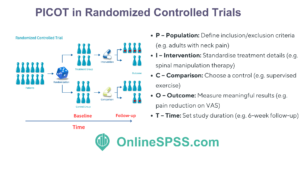
PICOT in Randomized Controlled Trails
In practice, a well-formulated PICOT question might read:
In [Population], how does [Intervention] compared to [Comparison] affect [Outcome] within [Time]?”
Formulating a question in this structured way ensures that the inquiry is specific and answerable. It “succinctly gives structure” to clinical or research questions, helping to drill down to the essence of the query By clearly defining each element, researchers and clinicians can identify relevant evidence and design studies to address the question directly.
3. How to Write a Strong PICOT Question for DNP Capstone
Writing a strong PICOT Question for DNP Capstone starts with identifying a real-world clinical issue that is relevant, measurable, and feasible within your practice setting. Your question should be specific enough to guide data collection and statistical analysis but broad enough to address meaningful outcomes. Each component of PICOT must be clearly defined:
Population (P): Who is your target patient or group?
Intervention (I): What is the practice or change you want to evaluate?
Comparison (C): What is the alternative or standard method?
Outcome (O): What result do you aim to measure or improve?
Time (T): Over what duration will the change or outcome be assessed?
A strong PICOT question aligns with your Capstone project’s goals and supports evidence-based practice change. For example:
In post-operative adult patients (P), does scheduled nurse-led pain education (I) compared to standard discharge instructions (C) reduce readmission rates (O) within 30 days (T)?
By structuring your research around a focused PICOT question, you ensure a clear path for implementation, data analysis, and reporting. This clarity is critical not only for your own success but also for stakeholders and faculty reviewing your DNP project.
PICOT Examples
Example: As an illustration, consider a clinical research scenario asking:
“In adults with chronic neck pain (P), what is the minimum dose of spinal manipulation (I) necessary to produce a clinically important improvement in neck pain (O) compared to supervised exercise (C) over 6 weeks (T)?”
For instance, a bedside nurse might formulate: “In post-surgical patients (P), does a nurse-led ambulation program (I) versus no structured ambulation (C) affect the incidence of pneumonia (O) during the hospital stay (T)?”
Nursing educators and librarians collaborate to teach nurses how to develop PICOT-based search strategies to find the best evidence to answer such practice questions. In Doctor of Nursing Practice (DNP) projects, crafting a strong PICOT question is often the first step in addressing a clinical problem through evidence-based change.
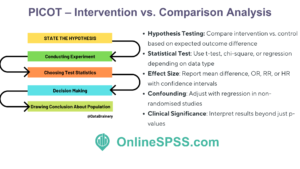
Understanding how each PICOT component influences statistical analysis is essential for designing and evaluating evidence-based studies. Researchers begin with defining the Population, applying proper sampling techniques, calculating sample size, and ensuring randomisation to reduce bias. In the Intervention vs. Comparison stage, they choose appropriate tests—like chi-square, t-tests, or Cox regression—based on the outcome type.
Comparison Analysis for DNP Capstone Project
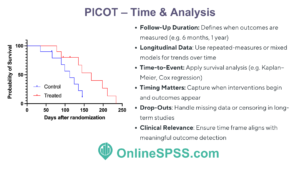
The Outcome element determines whether continuous, binary, or time-to-event methods are used, with emphasis on using validated measures and focusing on primary outcomes. Lastly, the Time component drives the use of longitudinal models, survival analysis, and endpoint comparisons, depending on the study duration and structure. Together, the PICOT format ensures methodological rigour, appropriate statistical choices, and clear alignment between the research question and analysis plan.
Time-to-Event Analysis in DNP Capstone Project
👉 Get a FREE Quote at OnlineSPSS.com to simplify your PICOT data analysis.
5. Get Help for PICOT Data Analysis
If you’re conducting PICOT-based research and require statistical expertise, OnlineSPSS.com is here to assist. Our specialists simplify complex statistical tasks, delivering clear, publishable results tailored specifically to your PICOT framework.
👉 Get a FREE Quote today to simplify your PICOT Question for DNP Capstone.
Need Help with Data Analysis?
Expert Statistical Data Analysis and Writing Services Tailored for Academic Research.
Get Accurate Insights, Reliable Results, and Professional Guidance.