Cohort Study Design: Prospective and Retrospective
Expert support for data analysing, interpreting, and reporting academic research. Get help with data analysis, methods, and writing results—accurate, fast, and tailored to your research study.
At OnlineSPSS.com, we offer expert statistical support and data analysis for all types of research design. We assist with cross-sectional studies, cohort studies (prospective or retrospective), randomized controlled trials, longitudinal designs, experiments, qualitative research, and mixed methods, delivering accurate, clear, and ready-to-submit results.
Who We Help: PhD Students, Researchers, Academic Staff Project Types:Dissertations, Academic Papers, Assignments, Research Projects, DNP Projects Our Services: Study Design, Data Management, Statistical Analysis, Writing Methodology, Reporting Results
Whether you work with IBM SPSS, R, Stata, NVivo, MAXQDA, Ms Excel or another software, our statisticians are experienced in all tools required for your Academic Research. From designing your study to interpreting final results, we’re with you every step of the way.
Click “Get Instant Quote” fill in required details, and upload supporting files.
2. Make the Payment
Pay securely through PayPal after receiving your custom quote.
3. Get Your Solutions
Receive high-quality, plagiarism-free results via email on time.
Introduction
In this comprehensive guide, you’ll learn what a cohort study is, how it works, and the difference between prospective and retrospective designs. We’ll explain its purpose, when to use it, and how to collect and analyse the data. Whether you’re planning a dissertation, academic paper, or professional research project, this content will help you fully understand the advantages, limitations, and proper application of cohort studies in academic research.
👉 Get a Free Quote Today and simplify your cohort study research with expert statistical help.
What is a Cohort Study in Research?
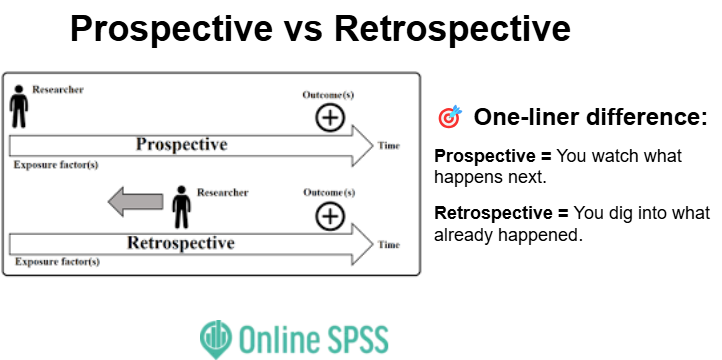
A cohort study is a type of observational research design where a group of people (called a cohort) is followed over time to investigate the relationship between exposure and outcome. Unlike case-control studies that look backwards from outcome to exposure, cohort studies begin with exposure status and track forward—or look backward, depending on the design.
There are two main types:
Prospective cohort study – follows participants from the present into the future.
Retrospective cohort study – looks at existing records to trace exposure and outcome from the past.
👉 Get a Free Quote Today and simplify your cohort study research with expert statistical help.
What is the Key Feature of a Cohort Study?
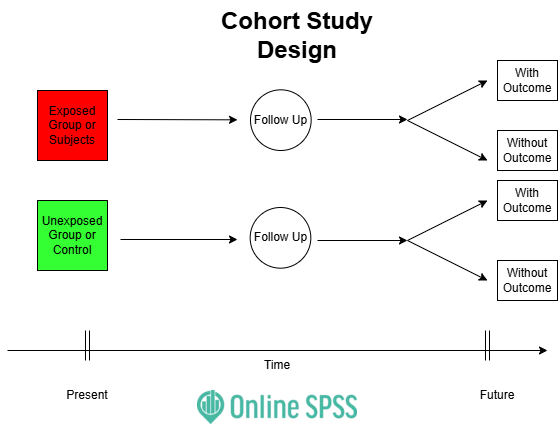
The defining feature of a cohort study is that it groups participants based on their exposure status and then observes them over time to see if they develop a specific outcome. The timeline and direction of data collection determine whether the design is prospective or retrospective.
Cohort studies can examine multiple outcomes related to a single exposure and are ideal for studying risk factors or the incidence of disease. Since they follow real-life situations without intervention, they provide valuable insights into causal pathways.
Prospective Chort Study Design Diagram
Key features:
Begins with a defined exposure group
Measures incidence rates of outcomes over time
Can study multiple outcomes from a single exposure
Ideal for establishing temporal relationships
👉 Get a Free Quote Today and simplify your cohort study research with expert statistical help.
Why Do We Use Cohort Studies?
Researchers use cohort studies to assess the risk or probability of developing a condition after exposure to a particular factor. These studies are essential when it’s important to determine whether an exposure truly precedes the outcome.
Prospective cohort studies are useful when researchers want to collect new data and follow participants over time, while retrospective designs allow use of existing records to answer research questions more quickly.
Reasons to choose this design:
Suitable for examining causal relationships
Used to calculate risk, rate ratios, and incidence
Allows study of multiple outcomes for one exposure
Enables long-term tracking of health outcomes
👉 Get a Free Quote Today and simplify your cohort study research with expert statistical help.
What is an Example of a Cohort Study?
Let’s consider a prospective cohort study that follows 5,000 non-smokers and smokers for 10 years to observe who develops lung cancer. Participants are grouped by smoking status at the beginning, and researchers record new diagnoses over time.
Alternatively, in a retrospective cohort study, a researcher might use past employment records from a chemical factory to identify workers exposed to hazardous materials between 1990–2000. They then use medical records to check how many developed respiratory illness by 2020.
Statistical Data Analysis Services
Example breakdown:
Exposure: Smoking or toxic chemical exposure
Cohort: Smokers vs non-smokers, or exposed vs unexposed workers
Outcome: Lung cancer or respiratory illness
Study direction: Prospective (new data), Retrospective (existing data)
👉 Get a Free Quote Today and simplify your cohort study research with expert statistical help.
Pros and Cons of Cohort Study
Cohort studies are highly valued for their ability to track events over time and determine cause-effect relationships. They’re especially useful for calculating relative risk and identifying factors that precede health outcomes.
However, they also have drawbacks. Prospective cohort studies can be time-consuming and expensive. Retrospective designs rely on existing data, which may be incomplete or inconsistent.
Pros:
Can determine causality more effectively than cross-sectional studies
Measures incidence and risk over time
Suitable for studying rare exposures
Allows tracking of multiple outcomes
Cons:
Expensive and time-consuming (especially prospectively)
Risk of loss to follow-up
Retrospective studies may involve incomplete data
Requires large sample sizes for rare outcomes
👉 Get a Free Quote Today and simplify your cohort study research with expert statistical help.
How to Collect Data for a Cohort Study?
Data collection in a prospective cohort study involves enrolling participants and following them over time with scheduled assessments. Data is collected through questionnaires, clinical exams, or digital monitoring tools.
In a retrospective cohort study, data is sourced from existing records—such as hospital records, employment databases, or registries. Researchers define a cohort based on historical exposure and trace outcomes using secondary data.
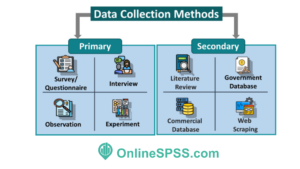
Data Collection Methods
Data collection approaches:
Prospective: Surveys, medical exams, health tracking apps
Retrospective: Hospital databases, employment records, public registries
Both: Require careful cohort definition and standardised outcome measurement
What is the Data Analysis of a Cohort Study?
Cohort study analysis involves comparing the incidence of outcomes between exposed and unexposed groups. Researchers use relative risk (RR), incidence rate ratios, and hazard ratios to determine if the exposure is associated with the outcome.
Analysis typically starts with descriptive statistics, followed by survival analysis or Cox regression in prospective studies. Retrospective studies may use logistic regression when timing isn’t precise.
Common metrics:
Relative Risk (RR) – compares outcome risk in exposed vs unexposed
Incidence rates – number of new cases over time
Hazard ratios – used in survival analysis to track event timing
Confidence intervals and p-values – to assess statistical significance
What Statistical Tests are Used in Cohort Studies?
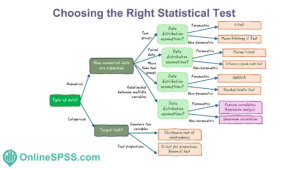
Statistical tests in cohort studies depend on the outcome type (binary, continuous, time-to-event) and data collection method. Time-to-event data often requires survival analysis techniques, while binary outcomes may involve risk ratios or logistic regression.
Cohort studies can involve complex modelling to control for confounding variables. Regression techniques adjust for age, gender, income, or other covariates that may influence outcomes.
Choosing the Right Statistical Test
Common tests:
Chi-square tests – for basic group comparisons
Relative Risk (RR) – for risk assessment
Logistic regression – especially in retrospective designs
Cox proportional hazards regression – for time-to-event analysis
👉 Get a Free Quote Today and simplify your cohort study research with expert statistical help.
How Do You Analyse Data in a Cohort Study?
To analyse cohort study data, researchers first clean and structure the dataset, separating participants by exposure status. They calculate incidence rates and relative risks, often stratified by important subgroups.
For prospective studies, time-to-event methods like Kaplan-Meier curves and Cox regression are applied. For retrospective designs, regression techniques help adjust for confounders. All analyses should report risk estimates, confidence intervals, and significance levels.
Steps to follow:
Prepare and clean the data
Define exposure and outcome groups
Calculate incidence and relative risk
Use regression models to adjust for confounders
Present results using clear tables and graphs
Statistical Data Analysis Help for Cohort Study
At OnlineSPSS.com, we offer expert support for both prospective and retrospective cohort studies. Whether you’re tracking patients forward in time or analysing existing data, our statisticians guide you from study design through final reporting.
Our experts provide tailored guidance on statistical tests, interpretation of complex data, and presentation of results in clear, publication-ready formats. We work closely with you to meet your specific research needs and ensure that your study’s outcomes are reliable and well-presented.
Our services include:
Study design consultation and review.
Data coding and cleaning tailored for cohort data.
Advanced statistical analysis using appropriate software.
Clear interpretation and guidance on reporting results.
Support in creating visualisations and APA-style reports.
👉 Get a Free Quote Today and simplify your cohort study research with expert statistical help.
📺 Visit our YouTube Channel for SPSS and qualitative data tutorials, tips, and academic writing guidance.
✅ Follow us on LinkedIn for useful Statistical Content.
Need Help with Data Analysis?
Expert Statistical Data Analysis and Writing Services Tailored for Academic Research.
Get Accurate Insights, Reliable Results, and Professional Guidance.