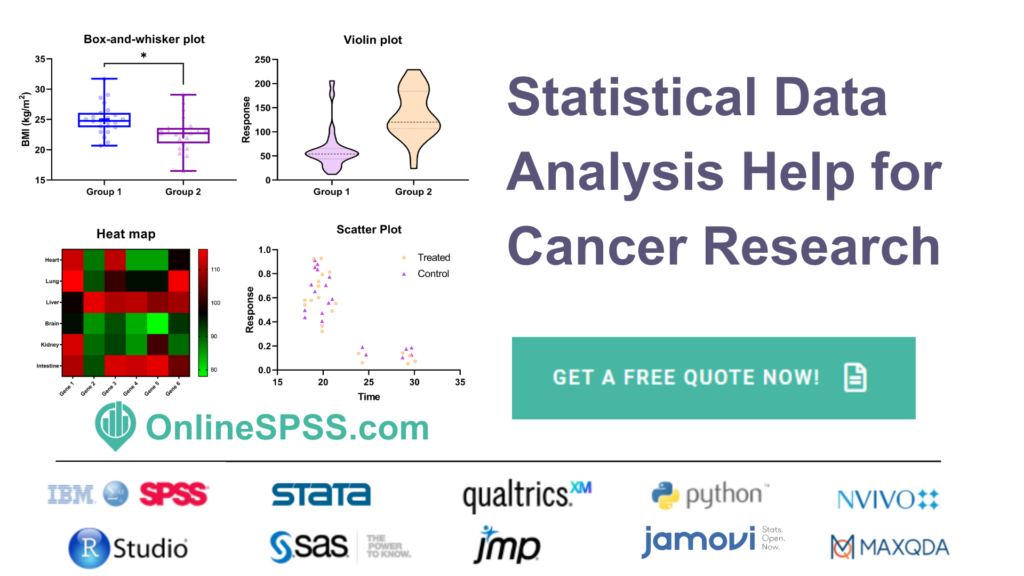
Statistical Data Analysis Help for Cancer Research
Expert support for analysing cancer datasets, clinical trials, and survival outcomes. Get fast, accurate, and publication-ready statistical help from oncology data specialists.
At OnlineSPSS.com, we offer expert statistical consulting and data analysis services tailored for cancer research. Our mission is to simplify complex statistical tasks, so you can focus on what matters most—your research impact in oncology. Whether you’re evaluating treatment efficacy, analysing survival outcomes, or studying quality of life in cancer patients, our team delivers accurate, timely, and publication-ready results.
Who We Help: PhD Students, Clinical Researchers, Medical Academics Project Types: Cancer Dissertations, Clinical Trial Theses, Survival Analysis Projects, Epidemiological Studies, Oncology Assignments Our Services: Data Management, Statistical Modelling, Methodology Support, Writing Results for Cancer Research
Whether you’re using SPSS, R, Stata, SAS, or another platform, our statisticians are fully equipped to handle the tools and techniques required for rigorous statistical data analysis in cancer research. From initial study design to final interpretation and reporting, we support you every step of the way.
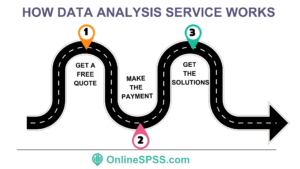
Click “Get Instant Quote” fill in required details, and upload supporting files.
2. Make the Payment
Pay securely through PayPal after receiving your custom quote.
3. Get Your Solutions
Receive high-quality, plagiarism-free results via email on time.
What is Cancer Research?
Cancer research is a vast and multidisciplinary field that seeks to understand the causes, progression, diagnosis, and treatment of cancer. It includes basic laboratory studies, translational research, epidemiological studies, and clinical trials. Researchers in oncology aim to develop new drugs, improve screening and prevention strategies, and evaluate treatment effectiveness in real-world and clinical settings.
Statistical Data Analysis Service for Cancer Research
There are two main branches of cancer research: pre-clinical research, which involves cell and animal models to explore disease mechanisms, and clinical research, which tests interventions directly with patients. Both areas rely heavily on data to generate evidence.
👉 Get a FREE Quote today and complete your cancer research project with confidence and clarity.
What Type of Data is Used in Cancer Research?
Cancer research involves diverse types of data, each providing unique insights into the disease process. Some of the most commonly used cancer data include:
Genomic and molecular data, such as gene expression or tumour profiling
Clinical data, including tumour stage, treatment response, and survival outcomes
Epidemiological data, collected from population studies and cancer registries
Patient-reported outcomes, such as quality of life or symptom burden
Imaging data, often used for tumour detection, segmentation, and tracking progression over time
We offer comprehensive statistical data analysis help for cancer research, ensuring your raw data is transformed into valid, interpretable findings.
👉 Get a FREE Quote today and complete your cancer research project with confidence and clarity.
Why is Data Analysis Important in Cancer Research?
Statistical data analysis plays a central role in cancer research. Without proper analysis, it is impossible to draw conclusions, validate hypotheses, or make clinical recommendations. Data analysis ensures that patterns are detected, differences are quantified, and risks are accurately measured.
In oncology, where outcomes such as progression-free survival or treatment toxicity are critical, the stakes are high. Statistical analysis helps determine the effectiveness of new therapies, identify biomarkers, evaluate population risks, and understand patient experiences. Whether it’s a small clinical trial or a national cancer registry study, valid data analysis is key to scientific credibility.
OnlineSPSS.com provides reliable support in handling cancer datasets, selecting the correct methods, and delivering results that meet academic and clinical standards.
👉 Get a FREE Quote today and complete your cancer research project with confidence and clarity.
What Statistical Analysis is Used in Clinical Trials?
Clinical trials in cancer research use a range of statistical methods to compare treatment arms, assess safety, and evaluate efficacy. The statistical techniques applied depend on the trial design, endpoints, and sample size.
Commonly used methods include:
Survival analysis, such as Kaplan-Meier and Cox regression, for time-to-event data
T-tests and ANOVA, to compare continuous outcomes between groups
Chi-square and Fisher’s exact tests, for categorical outcomes
Logistic regression, for binary endpoints like response rate
Repeated measures models, to assess changes over time
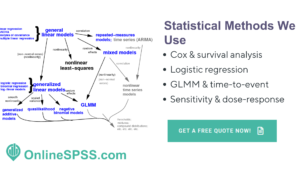
Statistical Methods for Cancer Research
Our team at OnlineSPSS.com supports clinical trial data analysis by applying rigorous methods and interpreting results clearly for regulatory, academic, or internal reports.
👉 Get a FREE Quote today and complete your cancer research project with confidence and clarity.
What Statistical Analysis is Used in Randomised Controlled Trials (RCTs)?
Randomised Controlled Trials (RCTs) are considered the gold standard in cancer research. They often involve complex statistical designs to minimise bias and adjust for confounders. Data from RCTs must be analysed using intention-to-treat principles, and multiple endpoints may be evaluated simultaneously.
Typical analyses in RCTs include:
Stratified randomisation analysis, to control for baseline variables
Mixed-effects models, to manage repeated or hierarchical data
Subgroup analysis, to assess treatment effects across patient populations
Hazard ratios and survival curves, to examine clinical progression
Interim analysis and stopping rules, based on statistical thresholds
At OnlineSPSS.com, we provide expert statistical data analysis help for cancer research RCTs, ensuring your findings are statistically sound and publication-ready.
👉 Get a FREE Quote today and complete your cancer research project with confidence and clarity.
Statistical Analysis of Cancer Data
Cancer data often involve survival times, tumour responses, adverse events, or longitudinal follow-ups. Analytical approaches must be chosen carefully to reflect the nature of each variable and the underlying research hypothesis.
We help researchers conduct:
Multivariable survival models, adjusting for demographic or clinical covariates
Log-rank tests, to compare survival curves between groups
Dose–response modelling, to evaluate toxicity or treatment thresholds
Meta-analysis, for pooled analysis of multiple studies
Exploratory data analysis, to identify unexpected patterns in early-phase research
OnlineSPSS.com tailors each analysis to your study’s objectives, guiding you from data exploration to statistical reporting.
👉 Get a FREE Quote today and complete your cancer research project with confidence and clarity.
Statistical Software Used in Cancer Research
Different tools are used across cancer research depending on data type and statistical needs. At OnlineSPSS.com, we work with the most widely used statistical software in oncology:
SPSS: Suitable for clinical trial data, survey responses, and basic regression
R: Ideal for advanced survival modelling and high-dimensional data
Stata: Excellent for longitudinal and epidemiological studies
SAS: Preferred in large-scale clinical trials and pharmaceutical settings
Excel: Useful for preliminary summaries and graphical reports
We adapt our support to your institution’s software preference and ensure that your analysis is both reproducible and easy to understand.
👉 Get a FREE Quote today and complete your cancer research project with confidence and clarity.
How It Works
Getting statistical support for your cancer research project is simple and efficient with OnlineSPSS.com. We follow a three-step process designed to meet your specific needs:
Submit Your Request – Tell us about your research topic, dataset, and deadlines.
Receive a Quote – We assess your project and provide a detailed quote within 24 hours.
Get Expert Help – Our statisticians handle your data, perform the analysis, and deliver results with full interpretation.
How Data Analysis Service Works
You’ll receive annotated outputs, clear explanations, and optional help with writing your methodology and results sections.
👉 Get a FREE Quote today and complete your cancer research project with confidence and clarity.
Get Data Analysis Help for Cancer Research
Cancer research is complex, time-sensitive, and high-impact. Don’t let your project stall due to technical issues or uncertainty in your analysis. Whether you’re preparing a clinical study, a survival analysis, or a dissertation in oncology, OnlineSPSS.com is ready to assist.
We combine deep statistical knowledge with experience in cancer data to deliver fast, reliable, and confidential support. From raw data to final report, we’re with you at every step.
👉 Get a FREE Quote today and complete your cancer research project with confidence and clarity.
Need Help with Data Analysis?
Expert Statistical Data Analysis and Writing Services Tailored for Academic Research.
Get Accurate Insights, Reliable Results, and Professional Guidance.